The Age of Autonomy: A C-Suite Guide to Agentic AI

Agentic AI is operational AI, and the 2026 decision is about operating model. What CEOs and boards need to decide before mid-2027.
July 14, 202625 min
Agentic AI is operational AI, and the 2026 decision is about operating model. What CEOs and boards need to decide before mid-2027.
Generative AI has gone everywhere, with mixed results. Although adoption hit 80% by 2025, only 12% of CEOs report meaningful returns. Agentic AI is the proposed answer out of the gridlock. Our argument: agentic AI is operational AI, and the 2026 decision is about operating model. Some agentic AI works in production today, but most of it is still in pilots. Gartner expects 40% of agentic AI projects to be canceled by 2027, and 88% of pilots fail to graduate to production. The cause is operating-model gaps (evaluation, governance, reliability). This guide for C-level executives covers what’s working, what’s repackaged, and what to decide before mid-2027: the technology basics, the open protocols (MCP, A2A) that reset the buy decision, named production deployments by industry, the regulatory milestones (EU AI Act, US state laws), and the seven decisions behind the 12% of pilots that scale.
01 The Rise of Agentic AIGenerative AI rapidly entered the mainstream in 2023, with nearly 80% of companies reporting some form of GenAI deployment by 2025. Yet paradoxically, roughly the same percentage report no significant bottom-line impact from these efforts. This “GenAI paradox” is widespread technology adoption with limited return. PwC’s 29th Global CEO Survey, published in January 2026, reported that only 12% of CEOs had seen meaningful returns from their AI investments to date. Closing this gap is what’s pushing business leaders to look at what comes next.
Agentic AI is the proposed answer: autonomous AI “agents” that turn AI from a passive prompt-in-answer-out tool into an active coworker. In many organizations, this is viewed as the next phase of enterprise change. In PwC’s AI Agent Survey of 300 senior executives (May 2025), 79% said AI agents were already being adopted by their companies. Three-quarters agreed that these agents would “reshape the workplace more than the internet did.” Analysts estimate the opportunity could exceed $3-$4 trillion in value for North America’s top 2,000 enterprises alone, according to McKinsey’s Seizing the Agentic AI Advantage. Per Gartner’s August 2025 forecast, 40% of enterprise applications will embed task-specific AI agents by end of 2026, up from less than 5% in 2025.
But the opportunity comes with a caveat. In July 2025, Gartner warned of “agent-washing,” its term for vendors rebranding existing chatbots, RPA bots, and rules engines as agentic AI without the underlying capabilities. By Gartner’s count, only about 130 of the thousands of vendors marketing AI agents are real. The category and the hype come with significant procurement risk.
For C-level leaders, the choice is to engage now and engage carefully. Companies that adopt agentic AI thoughtfully see meaningful gains in efficiency and growth. The cost of delay is competitive: peers with working operating models set the pace.
02 Agentic AI 101: Technology OverviewAgentic AI refers to AI systems (or “AI agents”) that have agency: the ability to perceive information, make decisions, and take actions autonomously in pursuit of goals. Agentic AI is designed to act on its conclusions. Traditional AI analyzes data and makes predictions without initiating action.
“AI agents are sophisticated AI programs designed to perform tasks autonomously, often interacting with their environment, making decisions, and learning from experience without continuous human intervention.”
Agentic AI draws on advanced AI techniques (foundation models, large language models, and other approaches) to achieve specific goals such as automating complex workflows and resolving problems on its own. Agentic AI generates insights and takes initiative on them.
A simple example: a tool that detects a pattern in data and then autonomously executes the next steps, such as adjusting prices, rerouting a shipment, or scheduling a follow-up meeting, within predefined limits set by its operators.
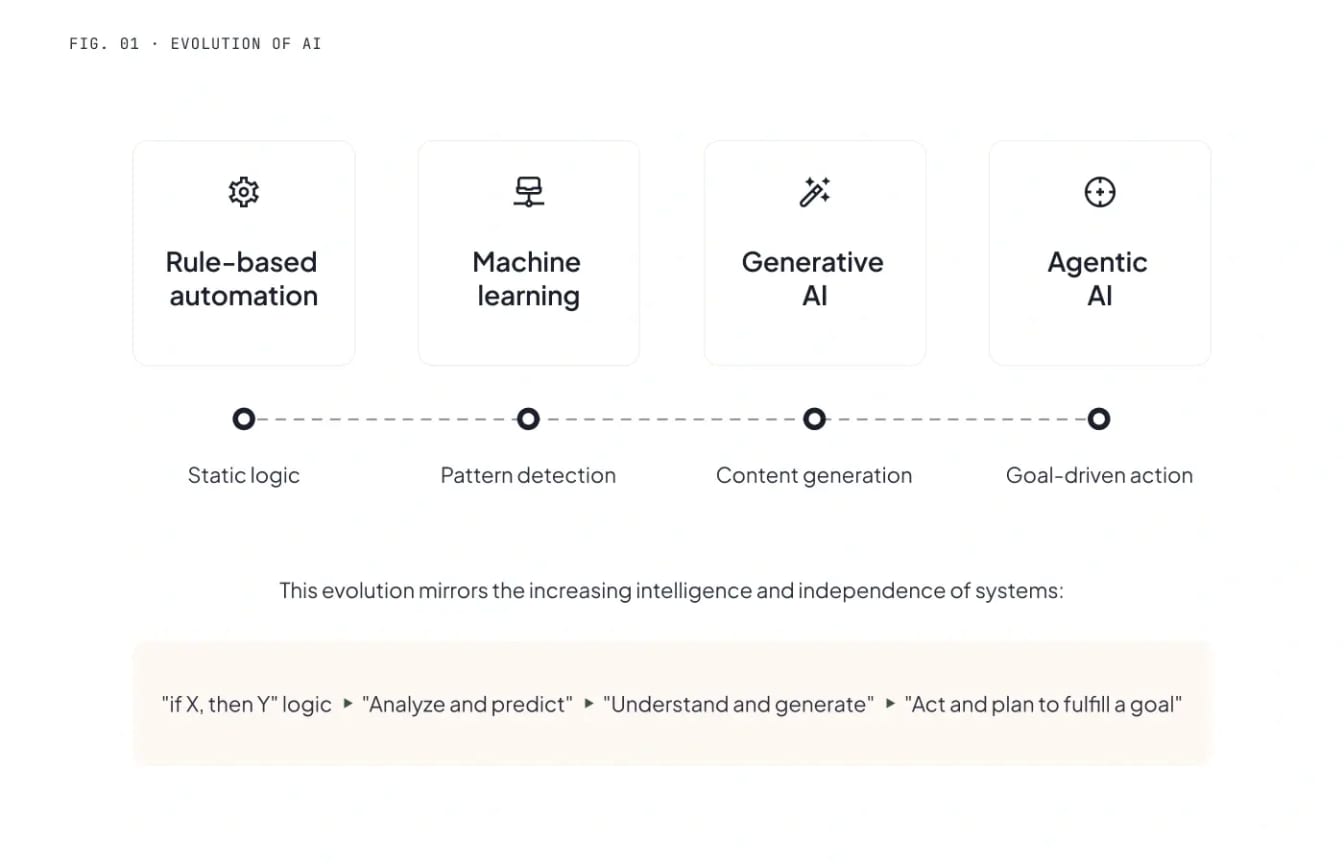
Traditional AI, and even many current generative AI applications, operate in a reactive mode. They produce an output (an answer, a prediction, a piece of content) in response to a prompt or query, and then stop. They do not continue iterating or make independent decisions beyond that output.
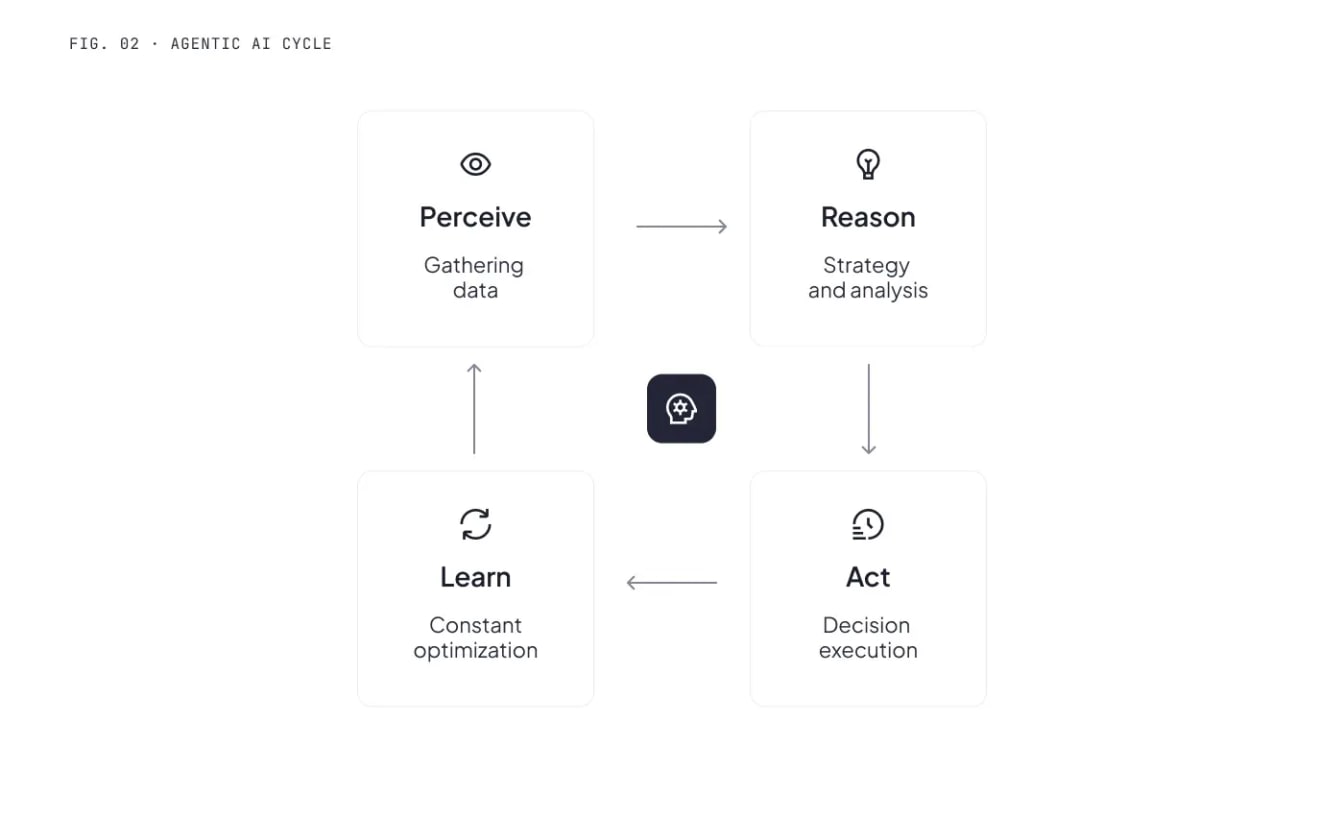
Agentic AI is built for autonomous execution. These agents observe their environment on an ongoing basis, reason through options, act, then learn from the outcomes. An agentic system runs a loop: perceive → reason → act → learn.
The AI agent can gather real-time data from various sources, use an AI model (for example, an LLM coupled with other algorithms) to plan and decide on an action, carry out the action by interfacing with software or real-world tools, and then absorb the results as new data to improve its future performance.
This feedback loop allows the agent to adapt and improve over time.
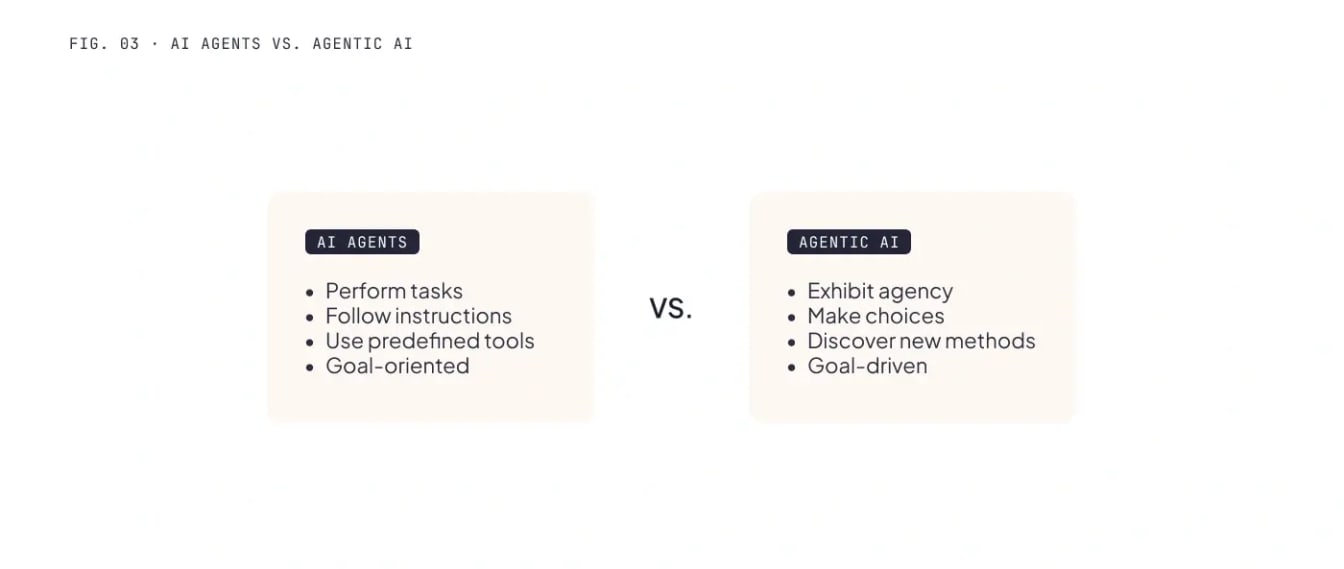
All agentic AIs are AI agents. Most software agents are not agentic. Many enterprises already use simpler AI or robotic process automation (RPA) “agents”: chatbots that follow scripts, or RPA bots that trigger predefined workflows. These perform tasks automatically but lack advanced reasoning or adaptability.
An agentic AI agent shows a higher degree of autonomy and intelligence. It adjusts its behavior based on context to handle novel situations. The main distinction is that agentic AI systems have a real capability for goal-driven decision-making.
This distinction matters because the market has moved faster than the labels. Gartner’s “agent-washing” warning tells buyers to test the agentic claim before accepting it. A useful approach is to ask three questions of any “AI agent” pitch:
Most “agents” in the market today answer no to one or more of those.
A traditional credit card fraud detection agent can automatically freeze a card when certain rule thresholds are met. An agentic AI in finance goes further. It weighs many transaction patterns, confirms with external data, decides whether to pause a transaction or require additional authentication, and even initiates customer outreach, all without explicit step-by-step instructions for every scenario.
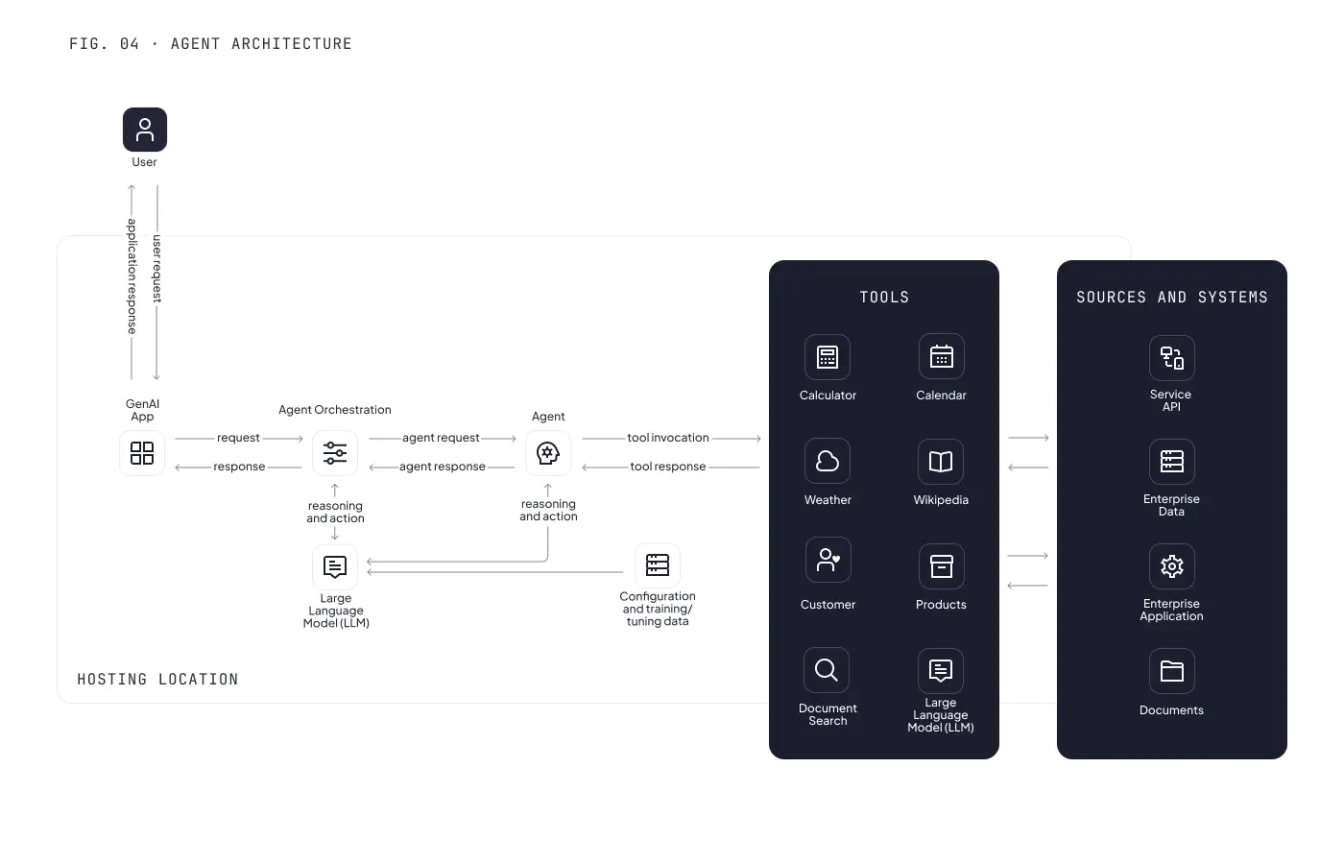
Modern agentic AI has three layers. A foundation model from Anthropic, OpenAI, Google, or another provider does the reasoning. Connectivity to external tools and data is handled by open protocols, principally MCP and A2A. Guardrails and observability make sure the agent operates within rules and stays visible to the team running it.
MCP (Model Context Protocol) was released by Anthropic in November 2024 to give agents a common way to call tools and read data from systems they were not pre-integrated with. By December 2025, MCP had grown to more than 10,000 active public servers and 97 million monthly SDK downloads, and Anthropic donated the protocol to the Linux Foundation’s Agentic AI Foundation, co-founded with OpenAI and Block, with Google, AWS, and Cloudflare backing the move.
A2A (Agent-to-Agent) was released by Google in April 2025 to let agents from different vendors discover, delegate to, and coordinate with each other. By April 2026, A2A had more than 150 partner organizations behind it. Together, MCP and A2A let agents from different vendors work together.
Buying a closed agent platform in 2026 is the equivalent of buying a closed CRM stack in 2002. The platform may work today, but replacing it later costs years and tens of millions. The first question to ask any agent vendor is whether they support MCP, A2A, or both.
Last are guardrails and observability. Well-built guardrails keep agents within business rules and regulatory limits, even as the agents operate with more autonomy. Observability lets the operating team see what the agent is doing and whether the outcomes match expectations.
As of mid-2026, most agentic AI systems in business are still maturing. Adoption has outpaced production. According to S&P Global Market Intelligence, only about 31% of organizations have an agent running in production, while 88% have an active pilot program. The most common deployment pattern is still a cognitive copilot or autonomous assistant for a specific task.
The trajectory is toward multi-agent networks: sets of specialized AI agents that collaborate (and interact with human teams) to handle complete processes. Thanks to advances in generative AI, the maturing MCP and A2A protocols, and a richer set of orchestration frameworks, the technology to build such systems is now in place. Major enterprise software vendors moved fast on the back of this: Salesforce Agentforce reached general availability in 2025 and Agentforce 360 shipped in early 2026 with claims of 85% customer-query resolution without human intervention; OpenAI introduced computer-use agents (Operator) and Anthropic introduced computer-use capabilities for Claude. In 2026, most enterprise software a CIO buys ships with at least one agent inside it.
There is a more sobering side, however. Gartner forecast in June 2025 that more than 40% of agentic AI projects would be canceled by end of 2027, citing escalating costs, unclear business value, and inadequate risk controls. The clearest cautionary tale of 2025 was Klarna: the buy-now-pay-later firm publicly replaced about 700 customer service agents with AI in 2024, then reversed course by mid-2025. CEO Sebastian Siemiatkowski admitted, “We focused too much on efficiency and cost. The result was lower quality, and that’s not sustainable.” Klarna is now operating a hybrid model where AI handles routine inquiries and humans handle nuance. Comparable course corrections played out at McDonald’s (whose IBM-built AI drive-through pilot was shut down after persistent order errors) and in the Air Canada chatbot ruling (where a Canadian tribunal held the airline liable for promises its chatbot made).
Agentic AI does work. Yet, early production deployments need three things: a clear definition of what “in production” means, a human in the loop for high-stakes actions, and a way to retire the agent if it underperforms.
Beyond agent-washing and the 40% cancellation rate, four other risks deserve direct board attention.
Over the next few years, enterprises can expect agentic AI to evolve from single-task assistants to more general autonomous coworkers embedded deeper in day-to-day workflows. Companies that get the governance right see their early gains build over time. The failed projects skew toward weaker governance.
03 The Agentic AI Advantage: Business Drivers and Benefits of AdoptionThree things are pushing agentic AI up the C-level agenda in 2026 and beyond. Each of these drivers turns on whether the company can run agents reliably. That is an operating-model question.
A single agent can run thousands of decisions in parallel, and multiple agents can work as a team without the coordination overhead that gates human teams. The output is either more work done without more headcount, or the same work done at lower variable cost.
Two named deployments show the scale of the shift.
For employees, the same shift opens room for higher-value work. Drudgery moves to agents; people focus on judgment, exceptions, and the work humans do best.
Agents run 24/7 and execute the same rules every time, reacting to events as they happen. That removes both the latency of batch decisions and the variability of human ones. The output is a more responsive operation with stronger compliance.
These deployments embed business rules and regulatory requirements directly into the agent. Agents adhere to their programming every time. With proper oversight, the same architecture supports both productivity and audit-grade compliance.
Agents open new revenue by doing work that doesn’t fit a human staffing model. Personalized engagement and real-time pricing now produce measurable revenue growth. Customer-facing AI also opens product categories that were not workable with humans alone.
R&D cycles get shorter on the same logic. Agents that run simulations or literature reviews bring new products to market faster. Capacity freed up in revenue-cycle and back-office functions pays for the experimentation.
Three numbers reframe the C-level business case.
04 Industry Fit: Where Agentic AI Can ThriveAgentic AI applies broadly. The strongest 2025-2026 production deployments cluster in industries with four characteristics:
The use cases below reflect named, in-production deployments as of mid-2026.
Finance is the most active agentic AI segment by named deployments. It is heavily regulated, document-heavy, and rule-bound. The data quality agents need and the audit trails regulators require are mostly in place. PwC’s AI Agent Survey found insurance executives placing agentic AI as their top tech investment priority for 2026, with 65% planning scaled AI agents for claims processing.
Agentic AI Use Cases.
Healthcare deployments in 2025-2026 have shifted from generic “AI for clinicians” to specific functional agents at the point of care. The focus is on the administrative work that pulls clinicians away from patients.
Agentic AI Use Cases.
Manufacturing and supply chain combine agents with IoT and computer vision. The 2025-2026 shift was from prediction to action: agents now negotiate, schedule, and route on their own.
Agentic AI Use Cases.
Retail in 2025-2026 has two halves: agents working for the retailer, and agents working for the customer. The customer side is the bigger structural change.
Agentic AI Use Cases.
Cross-industry functions are where 2025-2026 saw the most M&A activity and the biggest impact at the C-level. They are also where the employee experience and accountability questions are sharpest.
Agentic AI Use Cases.
The pattern across industries: data and operating model make the difference. Industries that did the digitization work earlier can deploy agents faster, because the missing pieces are the data quality and process clarity that let agents act reliably. More conservative industries are starting to engage with agentic AI as early successes and best practices show up. The operating-model lessons travel across sectors faster than the use cases.
05 Questions Executives Keep RaisingMost boards land on the same handful of objections. The recommendations that follow develop the answers.
“How do we know we’re ready?”
Three questions to ask. One: can the firm name a workflow that is document-heavy, rule-bound, and high-volume, with a measurable success threshold? Two: does it have an executive owner with a P&L for the program? Three: is the data behind the workflow clean and accessible, or behind years of integration debt? Two yes’s out of three is enough to start a pilot. One or zero says fix the missing piece first.
“What separates the 12% of pilots that scale from the 88% that don’t?”
Per the industry data, the leading blockers are evaluation gaps (64% of leaders), governance friction (57%), and model reliability (51%). All three are operating-model failures. The 12% have an accountable owner, a defined production threshold before the pilot starts, and a separate agent operations team.
“What’s the cost of waiting 12 months?”
Two costs. Operational: every quarter, a competitor’s agents accumulate data and tuning, and the lead compounds. Strategic: closed-platform decisions made by peers will become harder to undo at the same pace your industry consolidates around MCP and A2A. One cycle of waiting is recoverable. After two cycles, most companies never catch up.
“What if our industry isn’t ready?”
Almost no industry is uniformly ready. The pattern is that one or two workflows per industry are 18 months ahead of the rest. Find those workflows in your operation and start there.
Our reading: operating model first.
The dominant narrative frames agentic AI as a technology choice: which model, which framework, which platform. The failure data suggests operating-model gaps matter more. 88% of pilots fail, and the leading causes (evaluation gaps, governance friction, model reliability) are all operating-model problems. The companies in the 12% share a working operating model. Pick the operating model first; the technology choices get easier.
06 Strategic Recommendations for Adopting Agentic AIAgentic AI changes the operating model as much as the technology stack. C-level executives must approach it as a strategic change effort. Roughly 88% of agentic AI pilots fail; the 12% that scale share a recognizable set of practices.
This is the recommendation behind the 12% of pilots that scale. The 12% treat operating model as the first design decision. The single most overlooked C-level question in 2026 is who runs agents inside the company. Answer this first.
07 Customer SpotlightCitation’s agentic AI transformation is as much about operating model as about technology. What made the deployment work is the discipline around the agents. Citation, the UK’s largest provider of SME compliance services, applied agentic AI to two of its most document-heavy workflows: SMAS accreditation (UK health and safety verification for contractors) and ISO certification (international quality and security standards).
With extensive document review required, every new client added cost in near-linear proportion to revenue. Assessors spent the bulk of their time on manual checks before any expert judgment began. The compliance market is projected to reach $36.6 billion by 2033, and 65% of compliance leaders cite AI automation as the most effective lever to reduce cost and complexity. Citation needed to break the cost-per-client curve.
Provectus built an agentic AI platform on Amazon Bedrock with Anthropic’s Claude models. The platform classifies documents by type and security level, extracts and validates dates, detects and verifies signatures, and generates summaries assessors can act on. A self-service portal lets ISO customers upload and track their own documents, cutting back-and-forth and speeding up turnaround. The architecture is API-first, so new certification workflows plug in as the business grows.
AI Adoption Impact
Full Case Study: Certifying More Business Without Hiring More Compliance Assessors with Agentic AI.
08 Capturing Value in the Age of AutonomyAgentic AI is operational AI, and the 2026 C-level question is about choosing the right operating model. The work is how to put your firm in the 12% of pilots that move into production, to scale. Those decisions are specific, time-bound, and sit with the CEO and the board.
Five decisions worth making before the August 2026 EU AI Act deadline, and before the next earnings cycle locks in the 2027 operating budget.
Move the chosen workflow from pilot to production. Stand up the operating model behind it. Launch a second pilot in an adjacent function (the second is materially cheaper than the first if the foundations were built right). Track outcomes against the targets set in month one. By the end of the year, the firm either has two production agents and a working operating model, or has data on what blocked them.
According to Gartner, by 2029 agentic AI will be the “new normal” in how applications function and how workers interact with them, with over 50% of knowledge workers upskilled to work alongside or create AI agents. The companies that move with discipline now will shape that future. The rest will inherit it from competitors.
The opportunity and the risks are both real. The tools to manage them are now in market. What’s left is the decision to act, with the operating model in place from day one.
Provectus works with mid-market and enterprise teams on the integration, data, and governance work behind agentic AI. Get in touch if any of the decisions above are on your near-term list.