AWS re:Invent 2025 brought together over 60,000 in-person attendees in Las Vegas and reached 2 million viewers online. With thousands of sessions and hundreds of speakers, this year’s event marked a significant milestone: the transition from generative AI experimentation to agentic AI transformation, showcasing how autonomous, intelligent agents are reshaping the way enterprises operate, innovate, and drive value.
As an AI-first systems integrator and AWS Premier Consulting Partner, Provectus was excited to attend re:Invent 2025. This year, our team prioritized sharing expertise in AI/ML/GenAI, with a special focus on agentic AI. While connecting with clients and partners, we explored how the shift from traditional AI assistants (aka chatbots) to autonomous, intelligent agents can transform their operations, businesses, and entire industries.
As a $132 billion business growing at 20% YoY, AWS was eager to demonstrate its commitment to agentic AI. The company positioned agentic AI as an inflection point technology comparable to the arrival of the cloud itself. For enterprises navigating this transformation, AWS made it clear: In the future, AI agents will be the core driver for delivering business value from AI.
Below is a recap of Provectus’ experience at AWS re:Invent 2025, including the keynotes we attended, the innovations announced, and our insights into how agentic AI is driving enterprise transformation.
01 Overview of AWS re:Invent 2025
This year, AWS re:Invent was more than just another technology conference. It was a declaration that the AI era has finally evolved beyond Q&A-driven chatbots and use case-based AI assistants. The central message was unambiguous:
AI agents, not specific generative AI tools, will define the next wave of enterprise transformation.
This shift is as significant as the arrival of cloud computing, enabling organizations to reinvent how they build, operate, and innovate. In just a few years, AWS expects “billions of agents inside every company,” reshaping operations across diverse industries and internal corporate functions.
The conference strategically focused on the full stack required for autonomous intelligence – from specialized silicon to orchestration frameworks, governance mechanisms, and enterprise integrations. AWS positioned itself as the only provider with the full spectrum of capabilities needed to operationalize agentic systems at enterprise scale.
As always, keynotes were the cornerstone of re:Invent, featuring five stellar presenters:
We highly recommend watching all keynotes, but if your time is limited, prioritize the following three:
- Matt Garman’s keynote established the strategic context: while most organizations have experimented with generative AI, meaningful business ROI is only now emerging as AI assistants evolve into autonomous agents. Agents execute multi-step workflows, make context-dependent decisions, and scale human impact by an order of magnitude. AWS unveiled major infrastructure advancements, presented new custom and frontier models, and positioned Amazon Bedrock AgentCore as the enterprise-grade, one-size-fits-all service for agentic systems.
- Dr. Swami Sivasubramanian’s keynote drew a sharp distinction between automation of individual tasks and true collaboration of agents working together. He argued that while today’s models have shown impressive capabilities, efficiency, consistency, and reliability remain barriers to production deployment. The solution lies in building the foundations for agentic teammates (infra + models + HITL) that are trained through supervised learning, distillation, and reinforcement techniques.
- Dr. Werner Vogels’ keynote positioned AI as the next evolutionary wave in software development, introducing the concept of the “Renaissance Developer” – modern polymaths who blend creativity, systems thinking, and technical depth. He emphasized spec-driven development and reinforced that while AI accelerates code generation, it also heightens the need for human judgment, rather than reducing it.
Aligning with the event’s central theme – the rise of autonomous, agentic systems – AWS introduced several breakthrough services and announced major enhancements to its existing offerings.
At the core of AWS’s agentic AI strategy is Amazon Bedrock AgentCore, a powerful, modular agentic service designed for enterprise-grade autonomy. This represents a fundamental shift from building custom agent frameworks to using a secure, governed platform.

Core Capabilities
- Secure Session Runtime: Isolated execution environment for agent operations
- Memory & Context: Both short-term and long-term memory for learning and adaptation
- Tool Gateway: Safe, governed access to tools, applications, APIs, and other agents
- Identity & Permissions: Strict control over what agents can and can not do
- Observability: Real-time monitoring, transparency, and diagnostics
- Core Tools: Including Code Interpreter and Managed Browser
Amazon Bedrock AgentCore removes the engineering burden that has stalled enterprise deployments, enabling organizations to focus on business outcomes rather than infrastructure.
03 Breakthrough Governance
Among the most significant barriers to agentic AI adoption are control and predictability.
How do you trust an autonomous system to make decisions when AI models are inherently non-deterministic?
AWS addressed this challenge head-on with two governance innovations that fundamentally change how AI agents work.
Policy in AgentCore
Policies provide deterministic, real-time guardrails that operate outside the agent’s code itself. Unlike traditional approaches that rely on the AI model to follow instructions, Policies enforce rules at the platform level.

Organizations can explicitly define what agents are allowed to do. For example, blocking financial transactions above a certain threshold, restricting access to sensitive systems, or requiring human approval for specific actions. This means that agent behavior remains predictable and compliant, even as the underlying models evolve or are updated.
AgentCore Evaluations
Evaluations introduce systematic quality assurance for agentic systems.

Rather than deploying agents and hoping they perform correctly, enterprises can now continuously test for correctness, helpfulness, harm avoidance, and brand alignment. The framework includes prebuilt evaluators for common scenarios and supports custom scoring mechanisms tailored to specific business requirements. These features enable organizations to stress-test agents at scale before production deployment and maintain ongoing quality monitoring.
The strategic importance of these capabilities is huge. Together, Policies and Evaluations create an audit trail and governance framework that meets the requirements of regulated industries, where autonomous systems must be both powerful and provably safe. They transform agentic AI from an interesting experiment into a technology that legal, compliance, and risk management teams can approve for mission-critical operations.
04 New Models for a Multi-Agent Future
Amazon Nova 2 Family

AWS expanded its model portfolio with the Amazon Nova 2 family, designed specifically for agentic workloads:
- Nova 2 Light, Pro, and Sonic: Optimized for different agent use cases, balancing speed, cost, and capability
- Nova 2 Omni: The first unified model for multimodal reasoning (text, image, video, audio) and image generation
- Nova 2 AMI: Advanced multimodal intelligence for complex reasoning tasks
Amazon Nova Forge: Custom Frontier Models
Perhaps the most strategically important announcement, Nova Forge introduces open training models, enabling customers to integrate proprietary data at pretraining time. This creates custom frontier-grade models (“Novellas”) that deeply understand organizational context.

Nova Forge addresses a core enterprise challenge:
Aligning AI systems with proprietary knowledge and workflows, without losing reasoning ability. Organizations can now build agents that truly understand their business from the ground up.
Expanded Model Choice
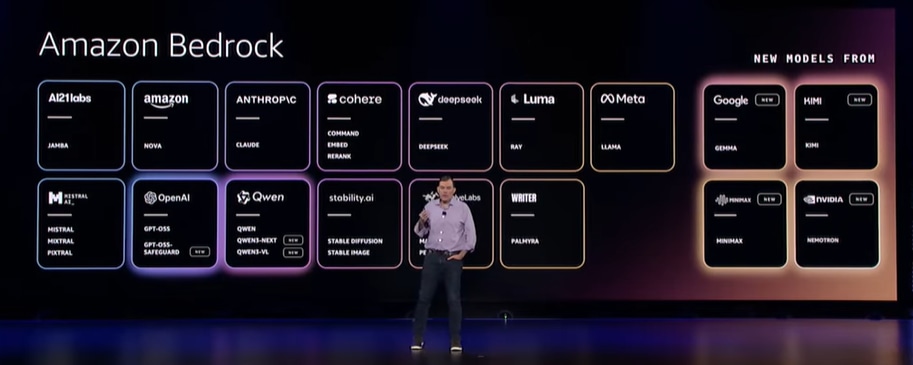
AWS added new open-weight models from Google, Mistral, MiniMax, and NVIDIA to Amazon Bedrock, reinforcing its commitment to model choice. The message is clear: there is no one-size-fits-all model for agentic AI.
05 Domain-Specific Agents
AWS announced three specialized agents for common enterprise needs:
- AWS Kiro Agent: Development and coding assistance, integrating with existing workflows to accelerate software delivery.
- AWS Security Agent: Automated security monitoring, threat detection, and remediation, enabling security teams to scale their impact.
- AWS DevOps Agent: Infrastructure management, deployment automation, and operational optimization, reducing manual intervention in DevOps workflows.

These pre-built agents demonstrate AWS’s understanding that enterprises need both platforms and solutions, reducing time-to-value while maintaining flexibility in customization.
06 The Strategic Impact for Enterprises
Agentic AI does not just replace and automate workflows, it redefines them. The transformation impact includes:
- Increased Productivity. Teams move from task execution to strategy and oversight. Agents handle the “work about the work”: triage, routing, drafting, researching, checking, testing, simulating.
- New Operating Models. Enterprises begin organizing around workflows powered by persistent, collaborative agents. Departments start building agent teams mirroring human teams.
- Lower Integration Costs. Agents can orchestrate existing systems rather than requiring deep systems reworks, reducing implementation costs and friction.
- Continuous Adaptation. Agents are smart enough to learn from outcomes and improve over time, reducing technical debt rather than adding to it.
- Innovation Velocity. The speed and scale at which new digital capabilities are created increases dramatically, unlocking new business models and customer experiences.
07 Provectus at re:Invent 2025
Provectus brought an energized team to Las Vegas, focused on sharing AI expertise and building connections around agentic AI transformation. Some of our activities included:
- Innovation Lunches – We hosted conversations with enterprise leaders over lunch, discussing how organizations are scaling AI initiatives to drive business impact with practical, real-world insights.
- Agentic AI Strategy Dinners – Invite-only event for business and technology leaders to exchange perspectives on adopting agentic AI across the enterprise, balancing innovation, governance, and ROI.
- Executive Dinners – Exclusive gathering for senior leaders exploring how generative and agentic AI can transform business operations and technology to accelerate growth.
Of course, the team attended keynotes and sessions, joined community activities, and helped partners and clients understand both the importance of Agentic AI for their business and Provectus’ readiness to support them.
08 Embracing the Agentic Future
AWS re:Invent 2025 demonstrated a fundamental shift in enterprise transformation: from generative AI tools to agentic AI systems that act, reason, and collaborate autonomously.
The vision of AWS is clear:
In just a few years, every employee will have agent teammates, every workflow will be agent-accelerated, and every enterprise will operate as a collaborative human-agent system.
Key innovations like Amazon Bedrock AgentCore, Nova Forge, and domain-specific models and agents showcase the commitment of AWS to making agentic transformation practical, secure, and scalable. Now, AI adoption is not just about technology, but about operational reality: the infrastructure, governance frameworks, and services that enterprises need to deploy agents that drive value.

For Provectus, these announcements represent extraordinary opportunities to help clients navigate agentic AI transformation. We are ready to enable organizations to:
- Break out of POC jail by deploying production-ready agentic systems
- Build custom agents that understand their unique business context
- Implement governance frameworks that balance autonomy with control
- Augment and scale human capabilities through agent collaboration
- Reimagine processes and operations from the ground up
The future belongs to organizations that can reimagine themselves, using agentic AI to solve complex business challenges. Industry leaders are already evolving their operations from software- to agent-driven, unlocking new efficiencies for their teams, clients, and partners.
Provectus is ready to help our clients lead their own agentic AI transformation.