Executive Summary
Rate is no longer the lever in commercial insurance. In the first half of 2026, Lloyd’s took a 6.7% risk-adjusted rate reduction, and property catastrophe reinsurance softened 12% at the January renewals. What is left is selection, settled at the top of the funnel in the minutes an underwriter spends on a submission. Selection at that speed should run on a knowledge base that the market has yet to build.
The agent’s knowledge is distributed across three tiers. Tier 1 is regulation (the set binding commercial property and casualty is narrower than most coverage suggests). Tier 2 is the class-and-peril vocabulary, where every line item has a supplier and every competitor holds the same one. Tier 3 is built from a carrier’s bound book and from the declines that never appear in it, and it has no supplier at any price. Written for chief underwriting officers, underwriting managers, pricing actuaries and MGA leadership, this article works through why the one layer that separates your decisions from a competitor’s is also the one being discarded every week. It closes with five questions that establish which tier you already hold.
01 Why Selection Sets the Combined Ratio
The headline result is being flattered
Lloyd’s of London, the world’s largest specialist insurance marketplace, reported half-year results on September 3, 2026. Gross written premium rose 6.9% to £34.7 billion and the combined ratio improved to 90.8%, from 92.5% a year earlier. The underlying combined ratio moved the other way, to 84.0% from 82.1%.
Two things carried the headline. The major claims ratio fell to 6.8% from 10.4%, and prior-year reserve releases rose to 3.5 points from 2.0. Light catastrophe experience and reserve releases produced the improvement. Neither is an underwriting decision, and neither repeats on request.
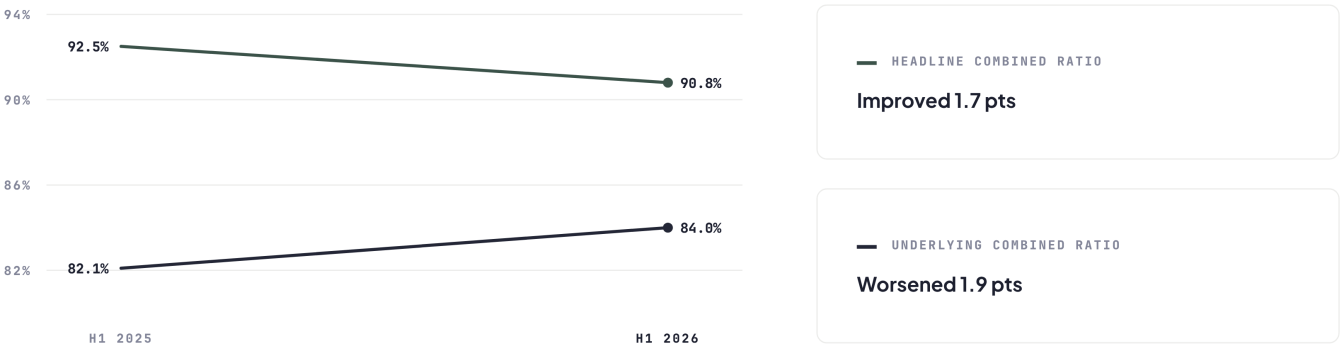
Lloyd’s headline combined ratio improved while the underlying ratio worsened. H1 2025 to H1 2026. A lighter major-claims ratio and bigger prior-year reserve releases produced the headline improvement. Neither is an underwriting decision.
The catastrophe half of that is market-wide and borrowed. Swiss Re Institute put 2025 insured natural catastrophe losses at $107 billion, against a long-term trend line closer to $140 billion, and reads the shortfall as favorable variability in a risk that has not eased.
Meanwhile risk-adjusted rates fell 6.7%, against 3.5% in the first half of 2025. Reinsurance moved the same way on January 1, 2026, with Guy Carpenter’s global property catastrophe rate-on-line index down 12% and Europe down 15%. By the mid-year renewals the same index had fallen 16% from January. Carriers are being paid less for the same risk, and the reported result is covering it.
The gap between good and bad underwriting is the whole return
BCG’s 2026 analysis of the US P&C market measured underwriting contribution across the 2021 to 2025 period. Top-quartile carriers generated roughly 11 percentage points of return on tangible equity from underwriting. Bottom-quartile carriers contributed negative underwriting returns over the same five years.
That spread is why the combined ratio is settled at intake, months before anyone argues about rate. It is settled in which submissions get read, which get quoted, and which get set aside without a second look. AI Underwriting: Why the Combined Ratio Is Won or Lost at Submission Intake works through the funnel math behind it.
Brokers now punish slow intake directly
Ivans, which operates the data exchange connecting independent agencies with carriers, surveyed 702 independent agents in April and May 2026.
- 90% of agents have reduced business with a carrier because of friction around submissions
- 76% said the digital submission and servicing experience matters to them more than commission
- Commercial-heavy agencies re-key risk data into carrier portals at a 70% rate, against 62% for personal-lines agencies
- Commercial submission automation is now the single capability agents most want from a carrier, at 79%
Whoever answers first tends to get the placement. Whoever declines fastest gets the week back.
Those figures measure friction in getting a submission through the door, which is a connectivity problem with a connectivity fix. The harder problem starts once the submission is inside. Answering first only pays if the answer is right, and a carrier that gets quicker at saying yes to risks it should have declined has bought itself a worse book at higher speed.
02 The Gap Between a Model and an Underwriting Decision
The Lloyd’s Market Association surveyed 39 managing agents in April 2026, together representing over 60% of Lloyd’s stamp capacity. Of those, 93% have an AI framework in place or in development. Over 60% require human oversight of AI outputs. A third have set up a dedicated AI governance committee.
But deployment inside core underwriting, pricing, and claims decisions remains limited.
While the models are available to everyone on the same terms and the governance is steadily built across the industry, knowledge remains the gap: what an agent has to know to be right about a specific risk, in a specific class, in a specific territory, under a specific set of house rules.
The obvious remedies work on capacity. More underwriters raise throughput on a straight line, and the headcount lands on the expense ratio that the loss ratio was meant to fund. Triage scoring ranks a queue against the appetite already encoded, so a thin appetite returns a confidently ranked queue of the wrong risks. A workbench puts the work on one screen and leaves the judgment where it was.
Deciding correctly at speed depends on what an underwriter can see about this risk against this book: the rule that binds it, the class language that describes it, and the pattern the house has seen before. Knowledge is the constraint, and it is the one left over after capacity is solved.
That knowledge has three tiers. Two of them are the same for every carrier in the market. The third is the one worth building.
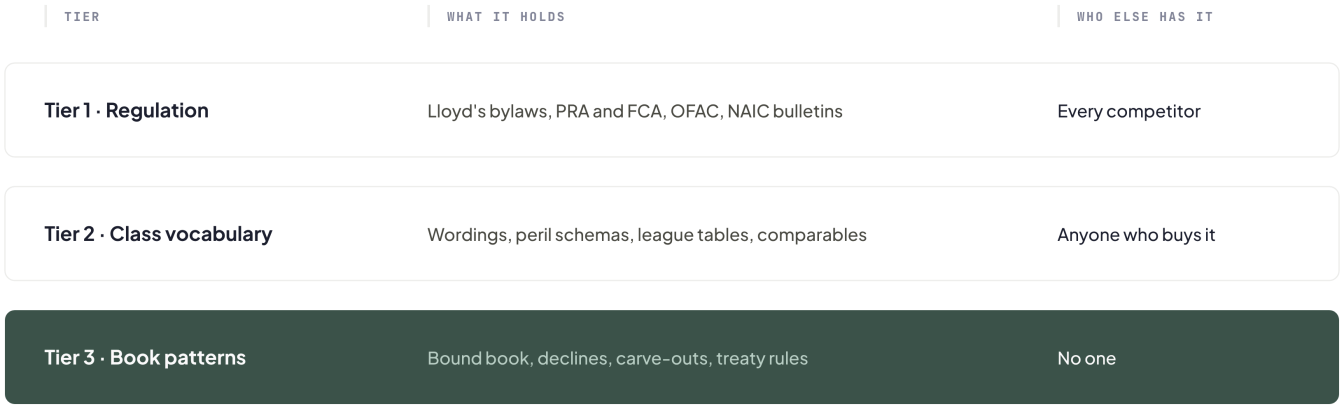
The three tiers of underwriting knowledge. Tiers 1 and 2 are the same for every carrier writing that class in that territory. Tier 3 has no supplier.
03 Tier 1: The Rules You Inherit
Lloyd’s bylaws. PRA and FCA guidance. OFAC and sanctions lists. OECD jurisdictions. NAIC model bulletins. This tier sets the boundary of what a carrier is permitted to write and how the decision has to be evidenced afterwards.
The AI rules that stop at personal lines
The instruments that may apply to commercial underwriting are narrower than the coverage of AI regulation suggests.
- Annex III of the EU AI Act, for example, classifies as high-risk those systems “intended to be used for risk assessment and pricing in relation to natural persons in the case of life and health insurance.” But commercial property and casualty falls outside it.
- Colorado’s SB21-169 and Regulation 10-1-1, effective October 15, 2025, cover life, private passenger auto, and health. Commercial lines are out of scope there as well.
- The PRA’s SS1/23 on model risk management applies to UK banks, building societies, and PRA-designated investment firms holding internal model approval. It does not apply to insurers, and it is cited in this context more often than it should be.
The supervision that does reach it
Prudential and market-conduct supervision constrains commercial underwriting.
Lloyd’s published its Market Oversight Plan for 2026 on January 13, 2026. It asks managing agents for evidence of proactive portfolio management where performance is weakening, and for pricing rationales that are credible and defensible. From January 2026 each managing agent has an assigned Delegated Authorities Oversight Manager running lifecycle reviews. Under the UK’s SM&CR, a named senior manager carries personal accountability for the decision an agent assisted.
The US route is more governance- than model-centered. The NAIC Model Bulletin on the use of AI systems by insurers was adopted in December 2023, and 23 states and the District of Columbia have adopted it. It requires a written governance program, a model inventory, and accountability for third-party vendors. New York DFS Circular Letter No. 7, issued July 11, 2024, adds documentation, testing before production and on a regular cadence, and audit rights written into vendor contracts.
Write the same risk in London, New York, and Denver and you inherit three different Tier 1 stacks. A carrier authors none of them. Every competitor writing that class in that territory carries the identical set. Tier 1 is a license to operate, and it is the same license everybody else holds.
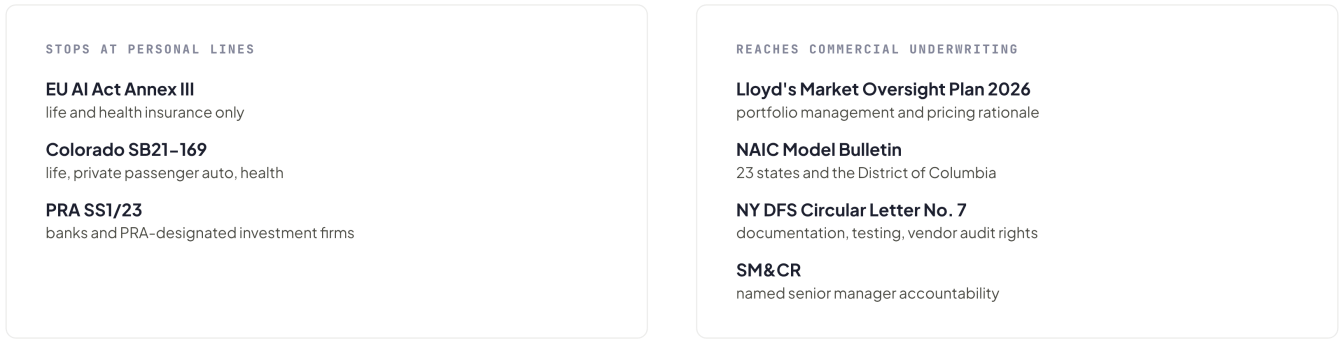
What Tier 1 actually binds in commercial underwriting. Most of the AI regulation written about insurance stops at personal lines. Prudential and market-conduct supervision is what reaches commercial property and casualty.
04 Tier 2: The Vocabulary You Buy
Class-of-business rules. Wording libraries. Peril-specific schemas for cat, cyber, marine, casualty, and D&O. Broker league tables. Market peer comparables. Exposure rating context.
Every one of these items has a supplier. In the London market the Lloyd’s Market Association publishes model wordings and clauses and revises them as the market moves. In the US, ISO files the standardized commercial lines forms most carriers write from. Catastrophe schemas come from the modeling vendors, Verisk and Moody’s RMS among them. Comparables and league tables come from the bureaus and from the brokers placing the business.
A carrier that has spent years on its wordings library has spent them on edits to a base layer every competitor also starts from. Tier 2 assembles with a purchase order and an integration project, which means it assembles the same way down the street.
Tier 2 is where most of the work happens. Tier 1 without Tier 2 gives an agent the law and no vocabulary. It knows a submission is inside sanctions and appetite, and cannot tell a high-priority recommendation from a low one.
Vocabulary changes line by line
A high-priority recommendation means one thing on an energy risk and something else on a financial lines risk, and the two will describe the same exposure in different language. Extending a platform to a new class of business means writing the configuration that class reads from. One pipeline serves every class. Each class needs its own vocabulary.
Necessary, bought at market price, and held by everyone else who bought it.
05 Tier 3: The Patterns Only Your Book Produces
Patterns from the bound book and the loss history. Appetite carve-outs. Broker performance scores. Treaty cession rules. The wording a specific team negotiates.
The decline is the key asset underneath all of it.
A book that learns only from itself keeps confirming itself
A carrier observes loss outcomes only for risks it bound. Everything declined is unobserved, and the models trained on what remains inherit the bias. Credit risk has a name for this and a literature to go with it: reject inference, the problem of a model that has only ever seen approved business. In specialty insurance the position is sharper. A declined submission carries a reason, recorded by a named underwriter, against a risk profile nobody else saw. That pairing of risk features to decline rationale exists in exactly one place.
It also explains why appetite derived from bound business will recommend more of the same business. It cannot separate a genuinely bad risk from one the house has simply never tried.
Tier 1 is published, so anyone can read it. Tier 2 is sold, so anyone can buy it. Tier 3 is produced by operating one book, under one set of authority limits, with one treaty structure and one group of brokers. There is no transfer path, because there is no version of it held outside the carrier that produced it.
The layer builds up with use
Every correction an underwriter makes to a system output is a labeled example that the carrier generated by working. On the Convex platform, every SME edit is logged, and every SME review teaches the classifier so that quality rises with volume. A competitor starting today needs the same years of corrections to reach the same place.
The judgment stays where it was. The reviewer cockpit routes edge cases to the SME: adversarial wording, unusual exposure profiles, the calls that need a person. Every generated claim traces back to a source region in the underlying report. That trace is what turns the NAIC and DFS documentation requirements into something an examiner can inspect.
A 100-page risk report that used to take days now returns a structured summary in about ten minutes. Against the same book, Convex triages 100x more risk reports than it could before.
Why more carriers have not done this
The layer accrues over years, which makes it a poor fit for the way these programs are usually funded. It shows almost nothing in the first quarter. No vendor sells it, so nobody is pushing it through procurement. It does not demo. Tier 2 buying produces a visible deliverable inside a quarter and a line item every committee recognizes.
The carriers that hold Tier 3 today mostly got there by instrumenting work their underwriters were doing anyway, and then leaving it to run.
For MGAs, the decline file is the business
Conning’s 2026 study put US managing general agent premium at roughly $128 billion for 2025, growing 12% against about 5% for the property-casualty market overall. An MGA writes on someone else’s paper and keeps the pen on the strength of its selection record. Appetite discipline is the product being sold to the capacity provider, meaning: the decline file is the thing the business is actually valued on.
Tier 3 carries the succession problem
Senior talent in specialty is aging out quickly, and the underwriters behind them often have not worked a full cycle. Writing down how a strong risk summary is built captured a decision standard that no longer varies with whichever SME happens to open the file.
06 How to Tell Which Tier You Are Missing
Five questions worth asking inside the business before asking anything of a vendor.
- Where do last quarter’s declines live? If the risk features and the decline reasons are scattered across email threads and broker calls, the Tier 3 asset has not been kept. It is being generated every week and thrown away.
- What happens to an underwriter’s correction? If a corrected output is saved as a document and nothing else, the system is not learning from the book. The correction is the training signal.
- Which appetite rules did a vendor write, and which did you? The supplied ones are Tier 2 by definition. The count of rules a carrier authored is a fair measure of how much Tier 3 exists today.
- Can a generated summary point at the page it came from? Citation back to source is what lets a carrier evidence the documentation and testing requirements under examination.
- How does a risk outside current appetite get tested? If the answer is that it does not, the book is confirming itself, and the appetite model will keep narrowing toward what it already knows.
We work through these five with carriers in Submission Flow, the Provectus blueprint for the top of the underwriting funnel. It starts from the baseline Convex spent three years tuning.
07 Conclusion
Rate is softening across the whole market, which leaves selection as the lever still under a carrier’s control. Selection runs on the knowledge an agent can reach in the moment a submission lands, and the tiers a carrier can buy are the tiers its competitors have already bought.
Tier 1 and Tier 2 make an underwriting agent legal and literate. Tier 3 makes it yours. That third tier is assembled out of material the business already produces every day and mostly discards: the declines, the corrections, the carve-outs, the reasons.
It accrues in the order the book generates it, which is the argument for capturing it now, ahead of the platform that will read it.
Start by establishing which of the three tiers your underwriting knowledge base already holds.
We build the system that makes all three reachable at the moment of a decision. We keep working alongside your SMEs, so Tier 3 grows out of the judgment they apply every day.
Talk to Provectus