The client is a US-based parametric insurance and reinsurance group that writes through a syndicate at Lloyd’s of London, the world’s largest specialist insurance marketplace. It covers hurricanes, tropical cyclones, typhoons and earthquakes, writes parametric earthquake reinsurance in South America and sells residential hurricane cover in the US. In each of these policies, a measured value such as rainfall, wind speed or ground shaking over an agreed area triggers the payout.
01 The Challenge
Parametric cover pays fast, so the climate numbers behind it have to hold up
Natural catastrophes caused $220 billion in economic losses in 2025, and only about 49% of that was insured, according to the Swiss Re Institute, the research arm of reinsurer Swiss Re. In emerging economies, 80% to 90% of catastrophe losses typically go uninsured. Parametric cover can reach part of that gap because it pays on a measured event, with no loss adjuster in the loop.
Paying on a measured value puts the weight on the climate data behind each policy. Before the insurer prices a policy, its actuaries need decades of climate history for the exact area insured, and after the policy binds, that data decides whether a claim triggers. A stale or wrong value can misprice a policy or turn down a valid claim.
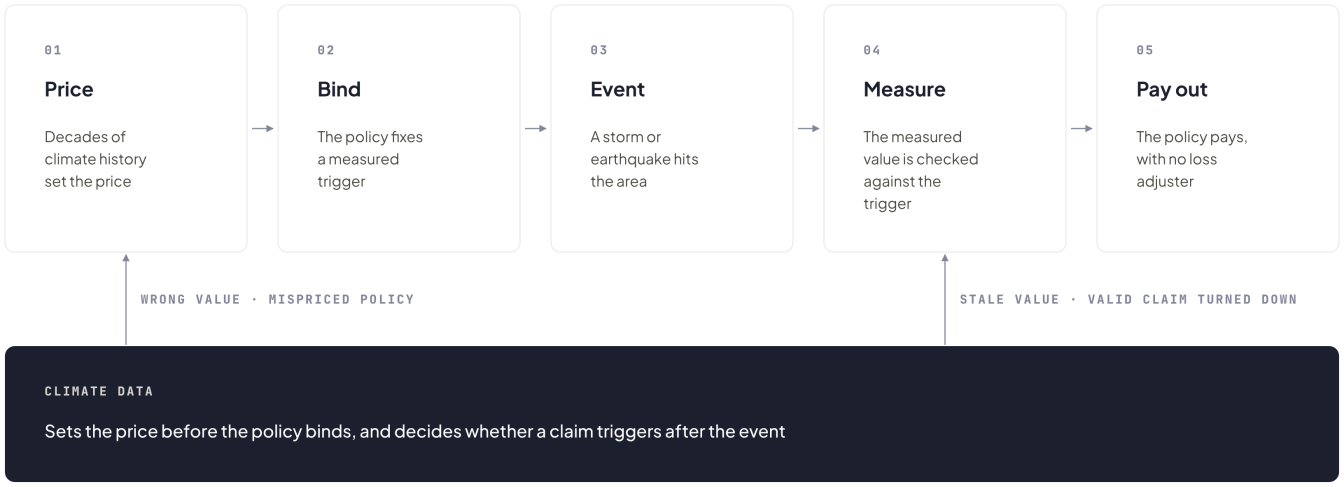
One climate value sets the price and decides the payout
Our client’s team used to gather that history manually. In discovery, the team estimated that finding, downloading and cleaning climate data took about 60% of its pricing work. Most of that effort went into questions like: how much rain fell over a given area in a given period, and how unusual was it? Each answer meant finding the right source, pulling decades of records and cleaning them before pricing work could start; the pricing engine that the team used drew on nine separate ingest paths across seven sources to keep up.
The insurer wanted an AI agent to shorten that path. An actuary would ask the question in plain language, and the agent would find the data across decades of global climate records and return a figure with the source and method behind it. The time spent gathering data could then go back into pricing and product design. The agent was the first step toward a larger goal: running underwriting, operations, finance and compliance as AI workflows, with people reviewing and approving the agentic output.
02 The Approach
A small engineering team, with a new part of the platform every two weeks
Provectus, an AI-first systems integrator and solutions provider, designed and built the platform for the client. It includes the climate data layer, the agent and the cloud environments they run in. A small Provectus team of data, AI and cloud engineers, led by an architect and a delivery lead, worked in two-week sprints, each ending with a demo of a new part of the platform. The team turned the insurer’s requirements into written specifications and built against them with Claude Code. The client’s head of actuarial joined the daily calls, so questions about pricing data reached the engineers the same day.
The first iteration put ERA5 behind the agent. ERA5 is the global climate record that Europe’s Copernicus program publishes back to 1940, and it is stored as hourly snapshots of the whole planet, so a year of rain for one city means opening 8,760 of them. The second iteration added CHIRPS rainfall records, the IBTrACS archive of storm tracks and IMERG, NASA’s satellite rainfall product.
Before any answer relied on ERA5, Provectus checked it against official rain gauge records. The archive was complete back to 1940, but it under-sizes short, intense storms: for example, Hurricane Harvey’s peak rainfall came out 40% to 60% low. That finding shaped the design. The insurer keeps a vetted list of which source to prefer for each question, users can override it, and every answer names the source it used.
As the platform took shape, Provectus and the insurer agreed on where the platform’s job ends: it handles the AI and the data, and the insurer’s team keeps the pricing, claims and settlement decisions. With that boundary set, the insurer’s pricing engine is moving onto the platform’s data.
03 The Build
A climate data layer with a full history, and an AI agent that checks every figure it gives
Provectus built two connected platform parts: a climate data layer that keeps every source with its full history, and an AI agent that actuaries question in plain language and that answers only from that data.
Every night, the data layer pulls fresh data from each source and stores it in two forms: a complete archive kept exactly as published, and ready-made daily and monthly figures for each location, so a year of rainfall for one city comes back in seconds. Corrections are added as new records next to the old ones, so the platform can show what the insurer knew on the day it priced a policy or assessed a claim. That matters because climate data often arrives late: 34% of ERA5-Land records land more than two hours after their stated publication time, and some arrive days later, so an answer used for settlement is tied to the exact version of the data it came from. Adding a new data source means adding a configuration entry to the same process. The data layer runs on Amazon MWAA, AWS Batch and Amazon Athena in the insurer’s AWS accounts.

What the insurer knew on the day it decided
When an actuary asks the agent a question, the work splits between AI and code. Claude Sonnet 5, running on Amazon Bedrock AgentCore, works out what the question needs: which source, which place, which period and which calculation. Code then fetches the data, does the arithmetic and logs every figure, and before an answer reaches the actuary, a check compares each number in it with that log. Claude Haiku 4.5 then checks that the answer addresses what was asked. When any check fails, the agent declines and says why, for example that the data doesn’t cover the area. Each answer names the product, area, period, method and data version it came from, and in testing a typical question is answered in about a minute.
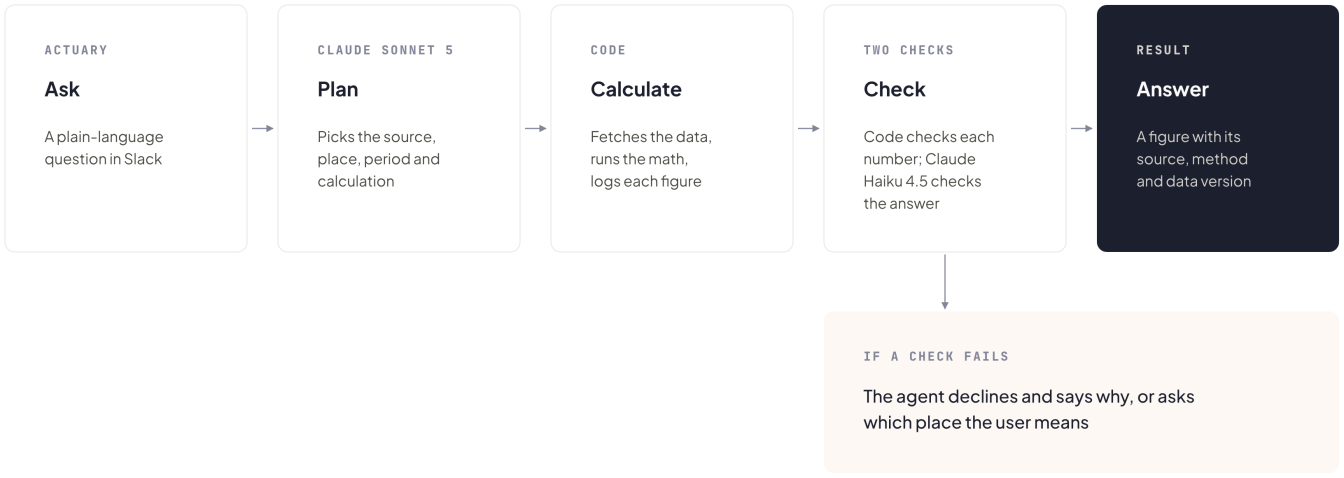
How a question becomes a figure an actuary can defend
Actuarial questions often need statistics on top of the raw figures, such as how much rainfall varies from one year to the next. Early in the build, a request from the insurer for the annual standard deviation of July rainfall in two cities showed that the agent could look figures up but couldn’t compute them. Provectus added a calculation step with named statistical operations that code runs on the data, and each result records the operation and its parameters, so an actuary can repeat it. Place names needed the same care: “Colombia” once resolved to a Cuban village of the same name, so the agent now asks which place the user means whenever two candidates are close.
Actuaries reach the agent through a Slack app. Each answer leaves a trace and a write-once audit record, and the platform is set up with separate development, staging and production environments in the insurer’s AWS accounts. The insurer’s engineers work in the same codebase: every change passes a Claude code reviewer on Amazon Bedrock and a human reviewer before it merges.
04 The Results
From climate data gathered by hand to figures an actuary can defend
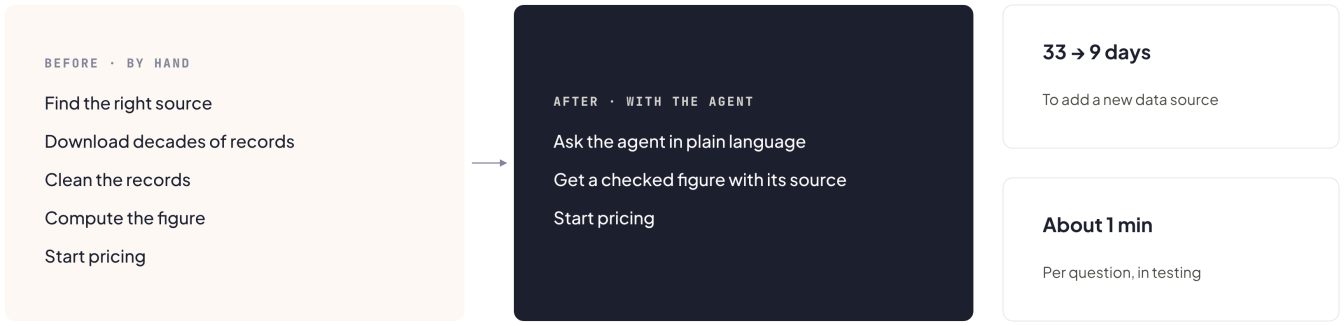
The same climate question, before and after the platform
The insurer now has the foundation for running its actuarial work with AI agents: one governed source of climate data, and an agent that turns plain-language questions into figures the business can back up. Each answer arrives with the source, area, period and method behind it, reproducible as of the day a decision was made. With ERA5, CHIRPS, IBTrACS and IMERG already behind the agent, the insurer extended the engagement and confirmed the next phase, which takes the platform into production.
From 33 days to 9 to bring a new climate data source onto the platform
Each new peril or index needs its data in place before the insurer can price a product on it, so the pace of adding sources sets the pace of the product line. The platform was built so the insurer’s team can add sources too: it brought the IBTrACS storm tracks and IMERG satellite rainfall onto the platform through the same review process as Provectus.
The first production release puts claims monitoring ahead of pricing, because several of the insurer’s new lines of business need it. Production starts in January 2027 with daily monitoring of live policies and same-day claim calculation, and the first deal priced through the agent follows by the end of that month.
Once in production, the platform changes how a figure is produced and checked for the insurer’s actuarial and claims teams:
- Actuaries start from figures the platform has already pulled and checked, so their time goes to the risk
- Each figure traces to its source, method and data version, so it holds up when a broker, reinsurer or auditor asks where it came from
- Any figure can be reproduced as of the day a policy was priced or a claim assessed, which matters when data is corrected after the fact
- The agent asks or declines when it can’t verify an answer, so a gap in the data shows up before it reaches a price or a payout
- Data and answers stay in the insurer’s AWS accounts, under its control
05 What’s Next
One climate data foundation for every peril the insurer adds
The insurer’s book is moving toward more perils and more regions, from earthquake shaking to hail and flood. Each one can join the platform as another source, so pricing and claims for a new product start from data that has passed the same checks and carries the same audit trail. Over time, the same base can support the insurer’s wider plan to run underwriting, operations, finance and compliance as AI workflows that its people review and approve, with Provectus building alongside the insurer’s team.