Generative AI Guide for Supply Chain Planning: Unlocking the Next Level of Value
A strategic roadmap for leaders ready to explore how GenAI can fundamentally enhance their supply chain planning capabilities and secure their organization's competitive advantage.
Download the full guideThe Role of Generative AI in Supply Chain Strategy
Supply chains are undergoing a once-in-a-lifetime transformation, driven by the rise of generative AI (GenAI). This technology is redefining how organizations access and manage data, make decisions, and drive operational efficiencies, enabling entirely new ways of managing supply chain complexity.
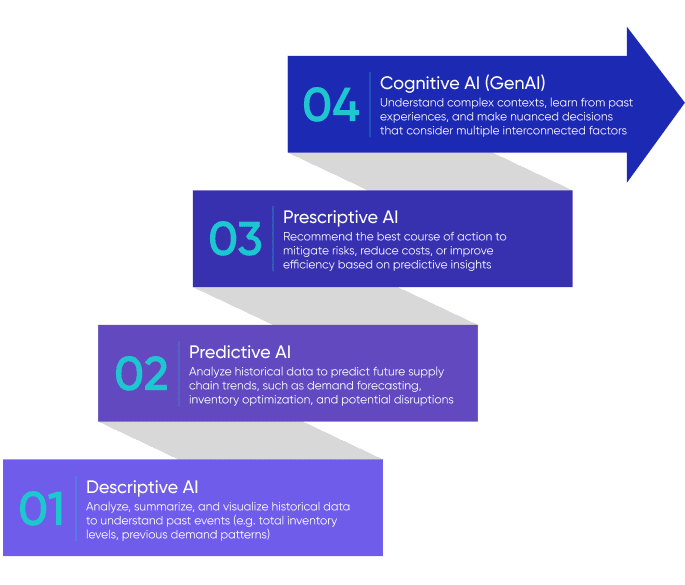
However, many enterprises engaged in supply chain operations are cautious about adopting GenAI, citing concerns around data reliability, output accuracy and transparency, and measurable ROI. With the supply chain industry already benefiting from descriptive and predictive AI, now is the ideal time for businesses to unlock the next level of value with generative AI — one capable of providing instant, intuitive insights accessible to all decision-makers, from planners to executives.
This guide offers a strategic roadmap for leaders ready to explore how GenAI can fundamentally enhance their supply chain planning capabilities and secure their organization's competitive advantage.

The Complexity of Supply Chains
Supply chains are intricate, globally interconnected ecosystems, operating amidst constant volatility, rapid shifts in demand, unexpected disruptions, and intense competitive pressures. Traditional planning methodologies, based on historical data and linear forecasting, have been used extensively and efficiently for decades, but their limitations become increasingly evident when unexpected events — like sudden market swings or supplier breakdowns — require immediate action, leaving planners overwhelmed and reactive.
To thrive in this environment, supply chain organizations need more than just historical insight; they require instant intelligence, adaptive responsiveness, and the ability to continuously explore alternative scenarios.
Unlike other types of AI, generative AI can serve as an intelligent, user-friendly assistant that augments supply chain professionals. It does not just analyze data; it synthesizes context-rich insights, creates real-time scenarios, and provides actionable recommendations. With GenAI, planners and executives alike can ask complex data-related questions, unlocking clear strategic guidance previously buried under mountains of structured and unstructured data.
The Generative AI Advantage
As generative AI moves from experimentation to practical implementation, its business benefits are becoming impossible to ignore. Leading supply chain companies are already applying GenAI to streamline operations, empower planners, and respond faster to supply chain disruptions. The measurable business impacts of generative AI can be broadly grouped into two key areas:
- GenAI-powered intelligent assistants utilizing natural language help planners rapidly identify risks, speeding decision-making and reducing disruptions.
- Streamlined and unified access to real-time insights from diverse data reduces manual effort and silos, freeing planners (as well as IT and data scientists) to focus on strategic priorities.

Imagine a supply chain planning environment where complex queries can be answered almost instantly, where potential disruptions are anticipated before they occur, and where strategic decisions are informed by AI-generated insights.
Take, for instance, a procurement manager facing global semiconductor supply uncertainties. Traditionally, gathering and processing comprehensive risk analysis data would involve days of manual research and cross-referencing.
With a GenAI assistant, the same manager can now receive a nuanced, probabilistic assessment of potential supply chain risks within seconds, simply by typing a couple of prompts in natural language.
- Generative AI can streamline the analysis of complex 'what-if' scenarios, modeling the impacts of geopolitical, economic, and technological shifts.
- Improved forecasting accuracy leads to optimized inventory management, reduced stockouts and lower holding costs.

Imagine an organization where access to supply chain insights is no longer restricted to data scientists or senior analysts. Natural language interfaces allow professionals at all levels to engage with sophisticated planning tools, breaking down traditional organizational silos and enabling more collaborative, informed decision-making.
In addition, advanced modeling capabilities of traditional AI/ML, coupled with GenAI, allow organizations to generate and evaluate hundreds of potential supply chain scenarios almost instantaneously. These are not simplistic projections, but sophisticated, probabilistic models that account for intricate global economic, geopolitical, and technological variables.
Generative AI makes it easy for teams to access and interact with supply chain data, converting complex, scattered information into clear, conversational insights. Instead of relying solely on data specialists, now any knowledge worker, from frontline planners to senior executives, can ask natural-language questions and instantly unlock powerful insights, develop actionable solutions, or generate entirely new scenarios. This democratization of data accelerates and scales smarter and faster decisions across the supply value chain.
Measurable business impact of generative AI


Key Opportunities for Supply Chain Leaders, Driven by Generative AI
Supply chain leaders who leverage generative AI gain a significant advantage in navigating complexity, responding to disruptions, and empowering their teams. Three key opportunities stand out:


Enable intuitive interactions, allowing planners to query against diverse data and receive clear, actionable responses in everyday language.
Drive efficiency and satisfaction by simplifying user interaction with complex supply chain planning systems.
- Natural-language queries for breaking down data silos
- Contextual understanding for interpreting nuanced queries
- Multilingual support for enabling global team collaboration
A procurement manager can ask, 'What are the potential risks for our chips supply chain over the next two quarters?' and receive a detailed report within minutes, including prioritized risk factors (supplier reliability, geopolitical disruptions, material shortages), likelihood of occurrence, potential business impacts, and recommendations for proactive mitigation.



Type in prompts to generate realistic planning scenarios, to anticipate and respond to market shifts, supply disruptions, and demand volatility.
Provide strategic foresight to knowledge workers at all levels, to enhance decision-making, making it more flexible and adaptable across the organization.
- Generate hundreds of potential supply chain scenarios
- Assign measurable risk probabilities to each scenario
- Continuously refine scenario generation based on real-world outcomes
A global automotive manufacturer used GenAI to generate scenarios for potential monsoon disruptions to their EV battery supply chain in Southeast Asia. The system identified a critical tier-2 supplier vulnerability, enabling the company to redistribute orders two months before flooding occurred.



Deliver concise daily summaries of key planning considerations, anomalies, or critical actions in plain language.
Empower planners and executives with timely, actionable 'next-step' intelligence, enabling rapid and informed decision-making.
- Contextual, comprehensive alert reports about subtle pattern changes
- Predictive, natural-language recommendations to suggest preemptive actions
- Compliance and optimization tracking capabilities
A CPG company used GenAI-powered daily insights to detect an unusual demand spike across regions. By correlating the pattern with a viral social media trend, the system recommended production increases two weeks earlier than normal processes would have.

Risks of Delaying the Adoption of Generative AI
Organizations hesitant to adopt AI/ML & GenAI risk facing tangible and escalating disadvantages:

Competitors leveraging AI/ML- & GenAI-powered tools can respond to market shifts in hours rather than weeks, reducing operational costs and winning customer loyalty through quicker, more personalized services. Late adopters risk permanently losing market share and customer trust.

Today's clients (and stakeholders) demand fast, intuitive interactions, like real-time data insights delivered in plain language. Companies unable to deliver these advanced, user-friendly experiences risk damaging client satisfaction, undermining their brand's reputation, and losing key accounts to more technologically advanced competitors.

Without AI, planners remain stuck performing tedious, manual tasks, increasing error rates and slowing strategic decisions. The inability to process and interpret data in real time means critical opportunities can slip away unnoticed, limiting overall business agility.
Generative AI is already transforming how leading companies manage supply chain complexities. Organizations that act now will rapidly turn data into insights and insights into decisions, gaining a clear competitive advantage in speed, agility, and resilience.
How to Get Started with Generative AI
Taking the first step toward adopting GenAI can feel daunting, but it does not have to be complicated. Provectus offers a clear, proven path forward with a structured program available through AWS Marketplace. Our subject matter experts and technical team guide your organization through every step, to help you quickly adopt and implement the most impactful GenAI use cases.
Data readiness and use case prioritization workshop, to help identify the best place to start for the highest return.
Building a Prototype to test the use case value and determine how impactful generative AI can be.