Brand Consistency with AI: What We Learned Building Brand Voice
Featured image
Six Provectus teams now make client decks, proposals, status reports and training material with Brand Voice, a Claude plugin that drafts in our voice, checks every claim that carries weight and builds the file in our design system. The first versions invented claims and hedged facts; the fixes apply to any company that makes client documents with AI.
Lena Mikheeva·Head of Design at Provectus
Maryna Oliinyk·Senior Product Designer at Provectus
November 19, 2026·11 min
BUSINESS SUMMARY
How Provectus keeps AI-made client decks on-brand and accurate with Brand Voice, a Claude plugin, and what we fixed. See how we set it up for your team.
Executive Summary
AI let every team at Provectus make client documents: decks, proposals, statements of work and status reports. A small design team could not check each one by hand, and model-written drafts drifted from our voice and our design system, sometimes with a figure nobody had supplied.
We built Brand Voice, a plugin for Claude. It drafts in our voice, checks tone and claims, and builds the file in our design system, and a person decides what goes to the client. Sales, leadership, delivery, marketing, design and the people team use it. A Solution Owner turned same-day call notes into a fact-checked two-page client deck in about 30 minutes.
The first versions invented claims to fill a slide count, hedged facts the author had heard from the client, and wrote setup guides like sales pitches. Each fix became a rule, and the rules apply to any company whose people make client documents with AI.
This article is for CMOs, brand and marketing leaders, and heads of sales and delivery whose teams send documents to clients.
01 AI Gave Every Team a Deck Builder
Generative AI moved client documents out of the design queue. In Adobe’s 2026 AI and Digital Trends survey of 3,000 executives and practitioners, 70% said generative AI had enabled non-creative teams to produce content. Sales, delivery and leadership can now build a deck in minutes.
Fewer of those documents get a careful read. In a 2025 study by the University of Melbourne and KPMG of more than 48,000 people in 47 countries, 66% said they rely on AI output without checking its accuracy, and 56% said AI had caused mistakes in their work. Researchers at Stanford Social Media Lab and BetterUp Labs surveyed 1,150 US employees: 40% had received AI-made work in the previous month that looked finished but did not move the task forward, and each case took nearly two hours to deal with.
Some of those errors reach clients. In 2025, Deloitte Australia, a member firm of Deloitte, one of the Big Four accounting and consulting firms, refunded about A$97,000 of an A$440,000 government contract after a university researcher found fabricated references and a made-up court quote in its report. The revised report disclosed that generative AI had been used to write it.
The brand slips as well. In Adobe’s brand research, published in November 2026, 74% of content approvers said they had signed off on off-brand content. Leaders estimated that 9% of their public content was off-brand; the people closest to the work put the figure at 27%.
Provectus went through the same change. Before AI, a client deck that had to look like Provectus went to the design team and waited in its queue. With AI, anyone at the company could build one in minutes, and our design team took on a new question: how to trust client documents that anyone can make.
02 Four Problems We Saw at Provectus
Once every team could make client documents, four problems showed up together.
The Brand Drifts
More people made more client material, each person with a different writing style and whichever template they had saved. A sales deck could still go out on an old template months after the new design kit was released.
Design Becomes the Bottleneck
On-brand output still depended on a small design team, so more documents meant a longer queue. As one Solution Owner put it, a lot of time went into getting decks to a clean, Provectus-styled standard. Presales waited for formatting, and designers spent their hours polishing other people’s slides.
The Voice Turns Generic
Model-written text tends to sound like a generic sales pitch. Clients hire Provectus as practitioners who know the subject, so a pitch-like draft costs us trust.
“This is not the way we speak,” says Stepan Pushkarev, Co-founder and CEO of Provectus.
Claims Go Unchecked
A model asked to fill a page will fill it, sometimes with a plausible figure nobody supplied. In a client document, a wrong number damages credibility; in a proposal, it can become a commitment.
03 The Usual Fixes We Tried First
Each of the usual fixes solved part of the problem and stopped short of the conversation between a person and an AI model, where the work is now done.
A Brand Guide
Designers who read our brand guide follow it. The model never gets it: the guide is a long document in a shared drive, and nobody pastes it into a prompt.
Templates
Templates keep the layout consistent. They do nothing for the wording or the facts, and they age: a sales lead told us our statement of work (SOW) templates were out of date.
AI Deck Tools
Some colleagues built decks in AI deck tools, and we considered adopting one to save time for Solution Owners and designers. The tools were fast, but the decks still went to design to fix the brand, so the design queue stayed as long as before.
Personal Prompts and Custom Assistants
They help the person who wrote them. Across a company, prompts need an owner to keep them current and a check on what they produce, and personal prompts have neither.
We needed brand rules the AI applies to every document, and checks that run before anything reaches a client.
04 How Brand Voice Drafts, Checks and Builds a Document
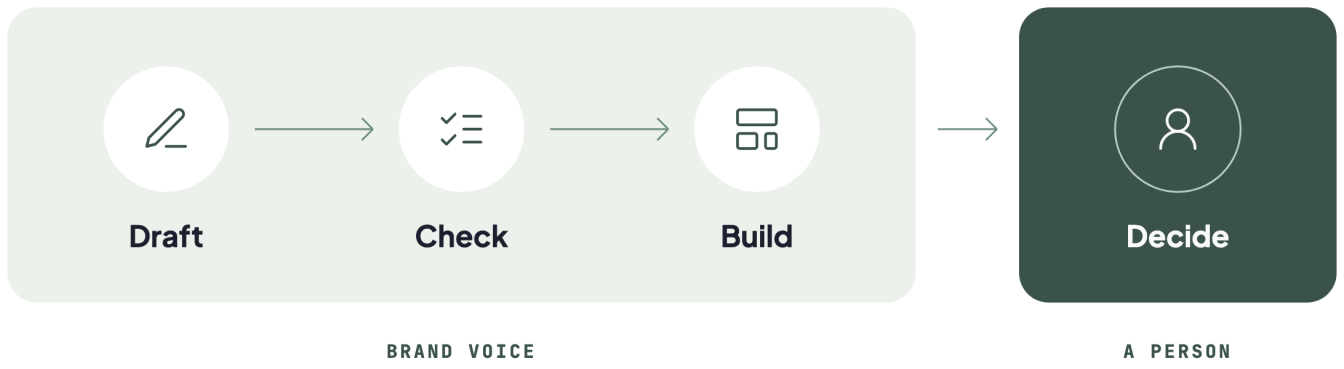
Brand Voice is a Claude plugin. People call it as a skill in Claude, which our teams use every day, whenever they make a client document. It does three things in order:
It drafts in our voice from whatever the author has: call notes, a brief, an earlier deck. The voice is written down as rules with examples, so “explain, don’t sell” means the same thing to every author and to the model.
It checks tone and facts. Every claim that carries weight has to come from a source or from the author. When something is missing, the system asks the author.
It builds the file in our design system: a deck, one-pager, proposal, web page or chart, as HTML, PDF, PowerPoint, Word or Claude Slides. A layout check looks for overflowing text, overlaps and type that is too small.
Then a person reads the result and decides what goes to the client.
The design team owns the system, because the design team owns the brand, and it makes most of the changes. The brand rules have an owner and a change history, and they change when someone using them finds a gap.
05 What the First Versions Got Wrong
Three problems in the first versions changed how the system works.
The Model Invented Claims to Fill the Slides
At first, a proposal had a target of 14 to 18 slides, and the system filled them. In one internal test, it invented 15 of the 34 claims in a proposal deck. An internal all-hands deck, built a different way and with no length target, had no invented claims. We added more prohibitions, and the invented claims kept coming. Then we turned every length into an upper bound, so the material sets the size of the document, and that fixed it.
For any company using AI for client work, invented content often starts in the brief: a required length tells the model to produce more than the author gave it.
The Fact-Check Made Our Writing Timid
At one point, the fact-check step could not ask the author anything, so it hedged. On one page it softened 14 of 32 claims into “some”, “often” and “we understand that”. It also doubted facts the author had heard directly from the client. We moved the decision to the author: facts the author supplies are accepted on the author’s word, open questions go back to the author, and a claim the draft added without a source is removed.
Every Document Sounded Like a Sales Pitch
For a while, the system wrote a client setup guide as if it were a pitch, and it overwrote the author’s wording. The voice now asks who a document is for and what it has to do, and it keeps the author’s wording when they ask for that.
Each of these rules appeared when people used the system on real client work; our brand guidelines had nothing on them yet. Whether a company starts with one team or with every team at once, early use finds gaps like these, so the rules need an owner who adds them.
06 Six Teams Now Start From the Same System
Brand Voice is used in every Provectus department that makes client documents (sales, leadership, delivery, marketing and design), and the people team uses it for internal training material.
Sales and Solution Owners
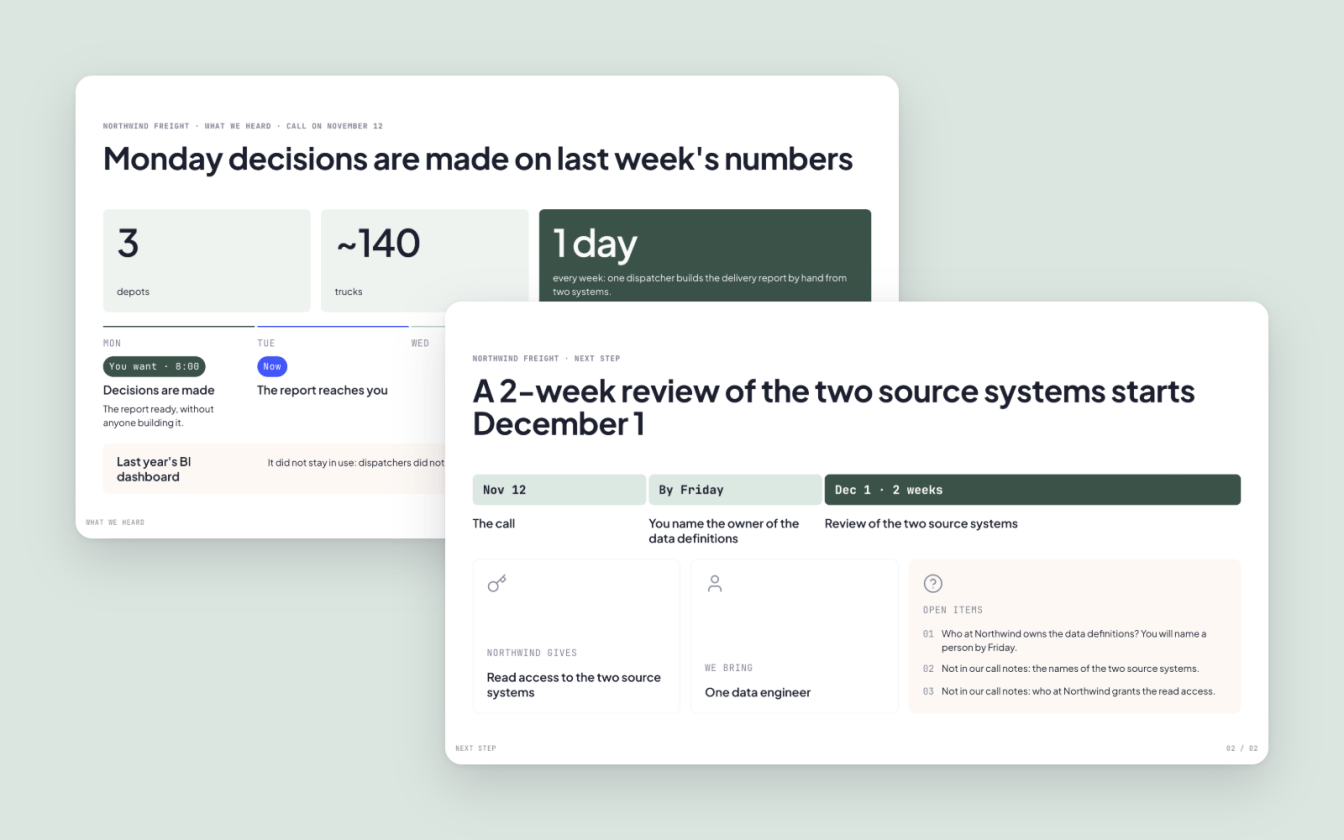
Client decks, two-page summaries, proposals and SOWs. A Solution Owner turned same-day call notes into a two-page client deck, fact-checked against the notes, in about 30 minutes. The system declined to state an outcome the sources did not support and listed it as an open item. After finding the SOW templates out of date, a sales lead styled a SOW with Brand Voice.
A sample two-page client deck built from call notes. The client is made up.
Leadership
A one-page offer for a private-equity firm’s portfolio companies went from request to a one-page PDF in about 10 minutes.
Marketing
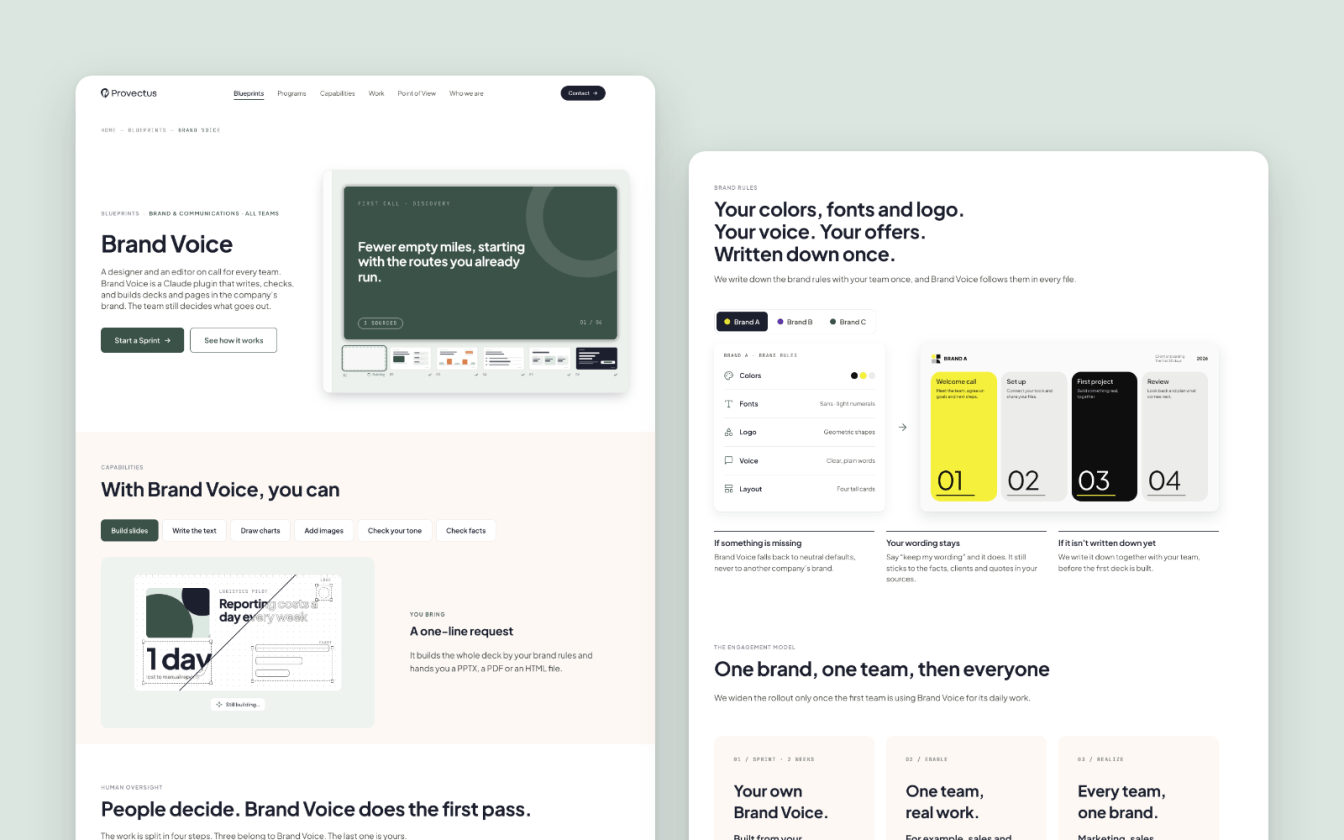
Web pages, case studies and decks. The Brand Voice blueprint page on provectus.com was built with Brand Voice, and a first deck draft takes about 20 minutes.
A delivery lead builds the weekly client status report with Brand Voice: what is done, what is in progress, what is blocked and what the team needs from the client, on one slide.
The People Team and L&D
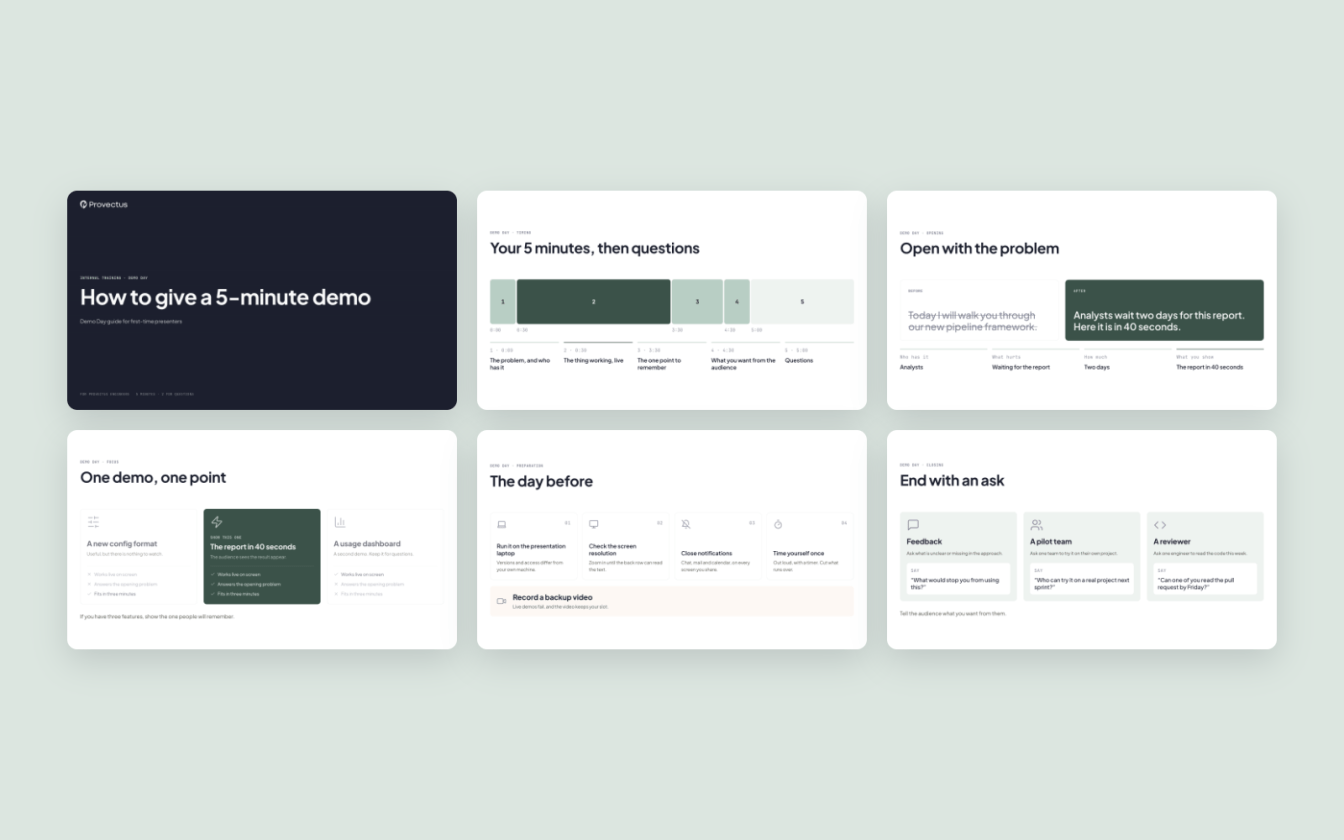
Internal decks and training material. For Demo Day, an internal event where colleagues present short demos of their work, project successes, insights and aha moments, L&D recommended Brand Voice to everyone preparing a presentation.
“This is actually huge, and very relevant for everyone who is looking to prepare for their Demo Day,” the L&D team wrote.
Sample training material for first-time Demo Day presenters, made with Brand Voice for this article.
Design
Designers maintain the brand rules the system applies. Decks reach clients without waiting in a design queue, and designers spend their time on design work.
What changed at Provectus:
first drafts of client documents in 10 to 30 minutes, from a request or call notes
design time back on design: designers maintain the rules, and decks skip the design queue
claims without a source flagged as open items before the file is built
one voice and one design system across six teams
07 What This Means for Your Team
A system like this is built around one company: its voice, its best work, its sources of truth and the rules nobody has written down yet. The method carries over to other companies (a first draft in the brand, checks on tone and facts, and a person who decides), and so do the lessons above, so your team can skip learning them on client work.
Three questions to ask your team first:
Who in your company sends documents to clients without anyone from design or marketing seeing them?
Where do your brand rules live today, and does the AI your people use ever see them?
When did someone last find an unsupported number in a client document before the client did?
We set up Brand Voice for other companies. We read your brand guide, templates and best decks, write your voice and company profile with your team, and hand over a working version built on one of your real documents. Brand Voice installs on individual Claude accounts or your enterprise account, your data stays in your company’s Claude accounts, and your brand team can update the rules after handover. The setup and brand files are yours to keep. Clients we have set it up for use it in their work, including what they make for their clients.
Provectus is a Preferred partner in Anthropic’s Claude Partner Network. What the setup covers and what we need from you is on the Brand Voice blueprint.